Asymptotic Notation
Asymptotic Notation
Notes:
Big O:
- Gives the tight upper bound of the given function
- O(g(n)) = f(n)
- eg:- f(n) = n⁴ + 100n² + 10n + 50 g(n) = n⁴, is the upper bound
- g(n) gives the maximum rate of growth for f(n)
Guidelines for analysis:
- Loops:
- for(i=0; i<=n; i++) //executes n times m=m+2 //constant time
- total time = c*n = cn = O(n)
- Nested loop:
- for(i=1; i<=n; i++) //executes n times for(j=1; j<=n; j++) //executes n times k = k+1; //constant time
- total time = cnn = cn^2 = O(n^2)
- Consecutive statements:
- Add the time complexities of each statement
- If-else:
- the if-condition + either the then part or else part.
- if(length == 0) ==//condtion: constant== return false ==//then: constant== else ==//else part: (const+const)*n== for(i:1->n) ==//n times== if(condition) ==//constant== return false ===//constant==
- total time = c0 + c1 + (c2+c3)*n = O(n)
- Logarithmic:
- for(i=1->n; i=i*2)
- i is doubling every step so lets assume the loop is executing k times. 2^k = n; take log both sides = log(2^k) = logn = klog2 = logn = k = logn
- Similarly if i=i/2 then it would still be log(n)\
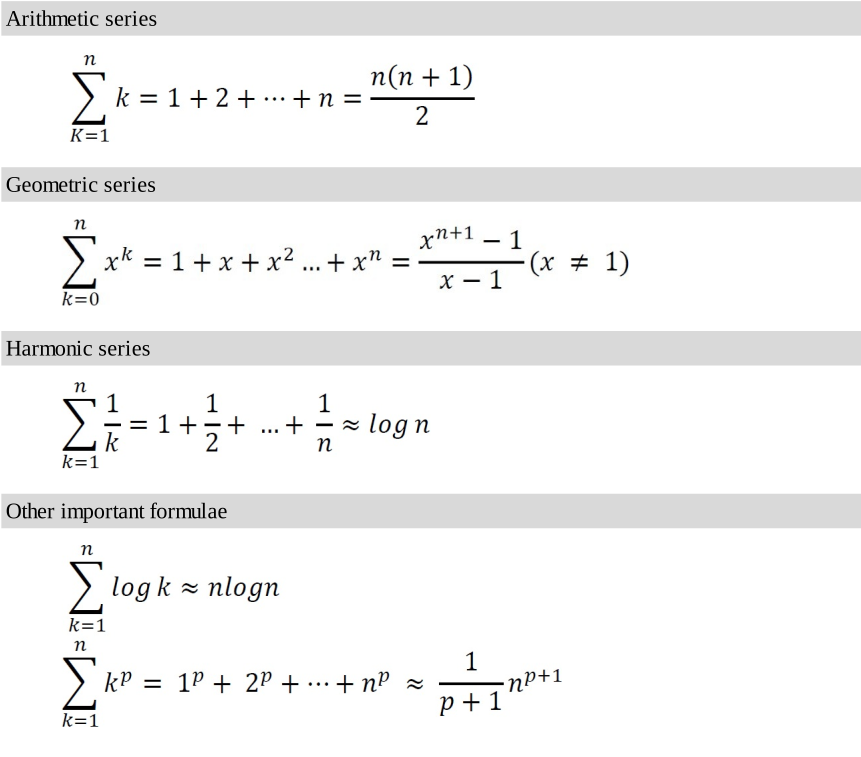
Some common formulae:
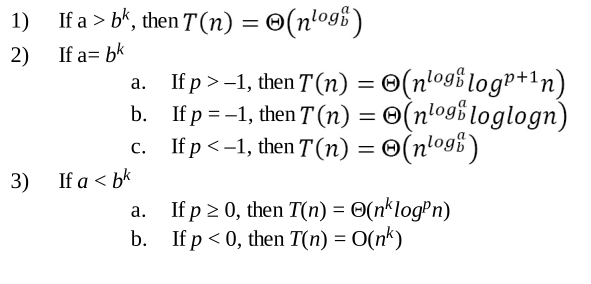
Master Theorem:
- Used to find the time complexity of divide and conquer algorithms or the algorithms where we have a recurrence relation given.
- If the recurrence is in the form:

- The time complexity is given as:
-
References:
This post is licensed under CC BY 4.0 by the author.